Precision and access
Laser settings can target selected areas and shapes, while blasting can cover broad surfaces efficiently with appropriate masking and media.
Laser cleaning, abrasive blasting and mechanical preparation all remove unwanted surface layers, but their behaviour differs. Laser cleaning can be targeted and avoids blasting media. Abrasive methods can be effective for large, robust surfaces and certain coatings. The safest and most economical option depends on the part, finish and degree of corrosion.
Whether your priority is better appearance, inspection access or long-term corrosion protection, the first decision is always the right method for the surface. That includes recognising when metal repairs must take priority over a cosmetic result.
Discuss your project ↗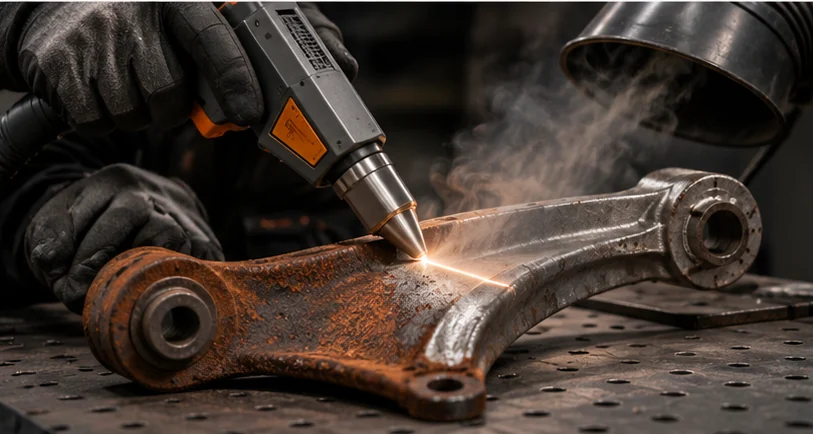 AI-GENERATED PROCESS ILLUSTRATION
Laser cleaning and media blasting both remove unwanted surface material, but they are not identical or universally interchangeable. Choosing by the condition of the metal and the coating specification is more useful than assuming the newest technology always wins.
| Factor | Laser cleaning | Abrasive blasting |
|---|---|---|
| Best suited to | Selective, localised, complex or precision work on suitable surfaces | Broad robust areas, certain thick coatings and specified blast profiles |
| How material is removed | Scanned light energy ablates/detaches unwanted surface layers | Mechanical impact of abrasive media |
| Secondary waste | No grit media, but collected particles and fume still need control and disposal | Spent media, dust and removed coating need collection and disposal |
| Surface effect | Can limit abrasion, but incorrect energy can still mark/heat substrate | Can create useful surface profile but may erode softer/thinner material |
| Access and speed | Good for accessible details; broad jobs can be slow | Efficient over large open areas with containment |
| After treatment | Inspection, suitable coating prep and protection still required | Inspection, suitable coating prep and protection still required |
We consider metal thickness, amount of corrosion, coating condition, work area access, ventilation, desired surface profile and final finish. Thin or complex parts may benefit from a precise process; a heavily corroded chassis may need several methods and metal repairs rather than laser cleaning alone.
See our Cork laser cleaning service and chassis rust removal pages to discuss your particular vehicle.
Wondering about budget? Read our laser cleaning cost guide for Cork before requesting a tailored quote.
Illustrations on this page are computer-generated examples of the technology, not photographs of completed customer work.
Every vehicle, finish and component is different. We focus on the considerations that genuinely affect the outcome.
Laser settings can target selected areas and shapes, while blasting can cover broad surfaces efficiently with appropriate masking and media.
Laser cleaning avoids abrasive media but can generate fumes and particulates requiring extraction. Blasting generates media and coating debris.
No cleaning method repairs perforation or metal loss. Surface preparation follows, rather than replaces, a structural assessment.
The visible result is only one part of responsible restoration. Before beginning we consider the substrate, corrosion severity, surrounding materials and practical access. Once cleaned, the surface may need immediate protection and, where appropriate, an inspection for hidden deterioration.
For underbodies and restoration work, this can involve degreasing, drying, accessible rust removal, compatible primer, topcoat, cavity wax and a suitable protective finish. Not every stage is needed on every job; the sequence is agreed after inspection.
EXPLORE THE TREATMENT PROCESS ↗Explore the services most often considered alongside this treatment.
Precision laser cleaning for Cork vehicles, components and machinery.
EXPLORE SERVICE ↗02 / SERVICERemove surface corrosion with precision, not unnecessary abrasion.
EXPLORE SERVICE ↗03 / SERVICEStrip the coating with the right method for the substrate.
EXPLORE SERVICE ↗No. Suitability depends on the material, condition, coatings, access and the end result. A condition assessment is the starting point.
No. Laser cleaning prepares appropriate surfaces; perforated or weakened structural metal must be properly repaired or replaced.
Compatible primers, topcoats, cavity waxes and underbody coatings may be recommended where appropriate. The final system depends on the specific project.
Send the vehicle or part details, location and issue through our enquiry form. A quote can be discussed after the scope and condition are assessed.
Send us the vehicle or part, the affected area and what you want to achieve. We’ll assess the next step.